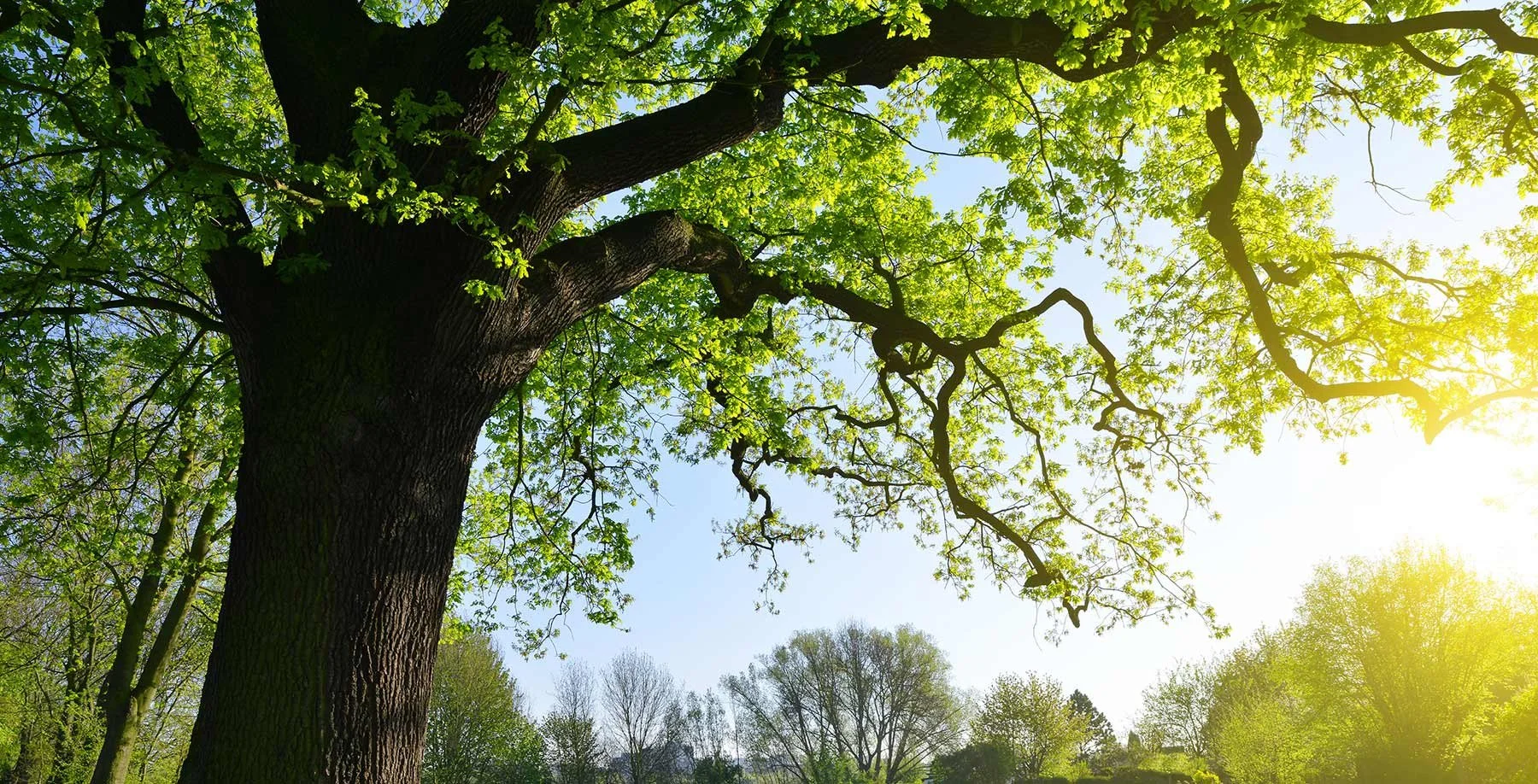
Tree Removal
We reach 115 feet, grip every piece before we cut, and work from your driveway. Not your typical chainsaw-and-a-prayer operation.
Get Your Instant
Tree Removal Estimate
Upload a photo of your tree, tell us what's going on, and get a ballpark number in under 30 seconds. We'll follow up within a business day to set up an on-site visit.
Free. No obligation. Takes about two minutes.
Not Your Average
Tree Service
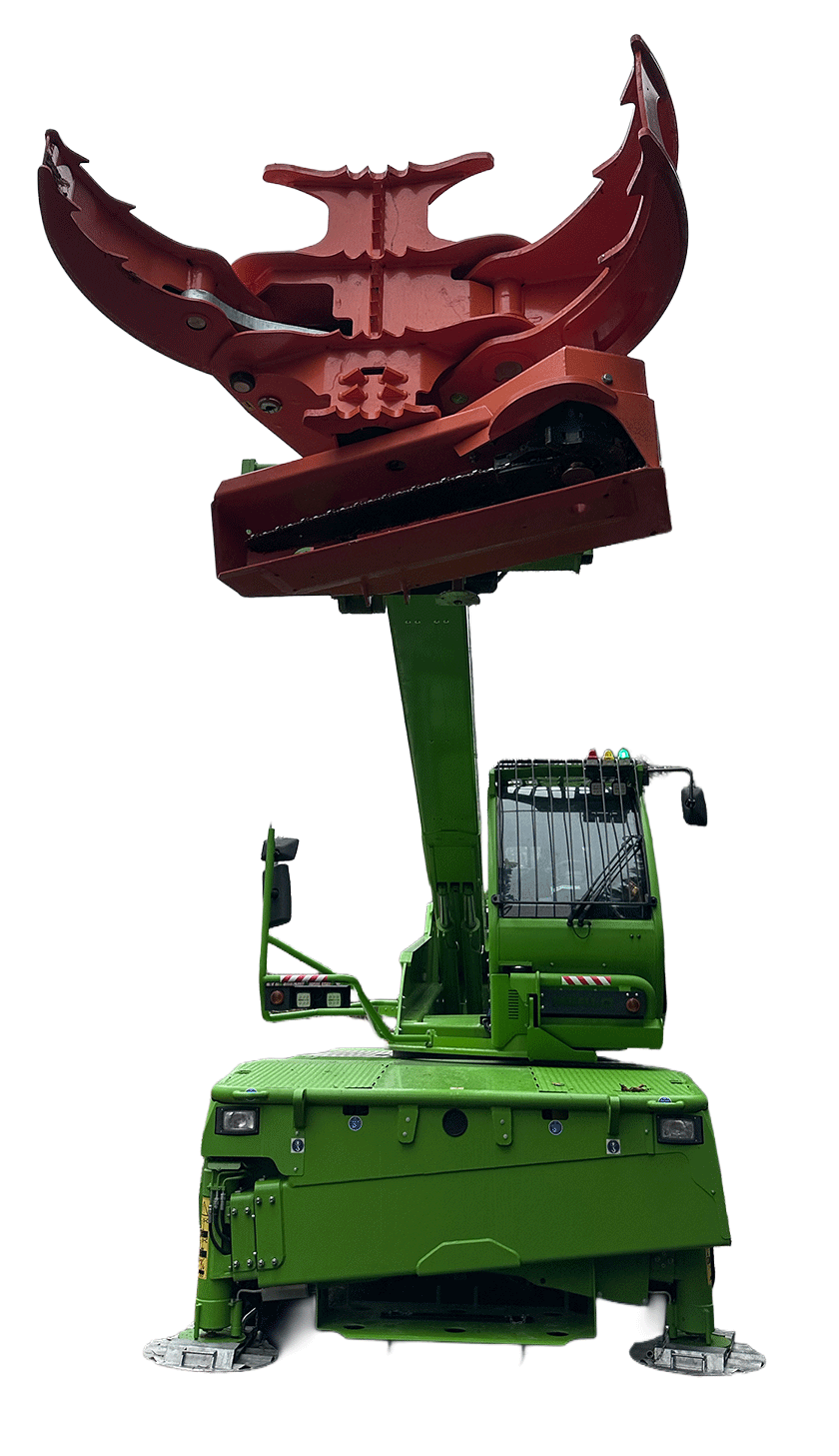
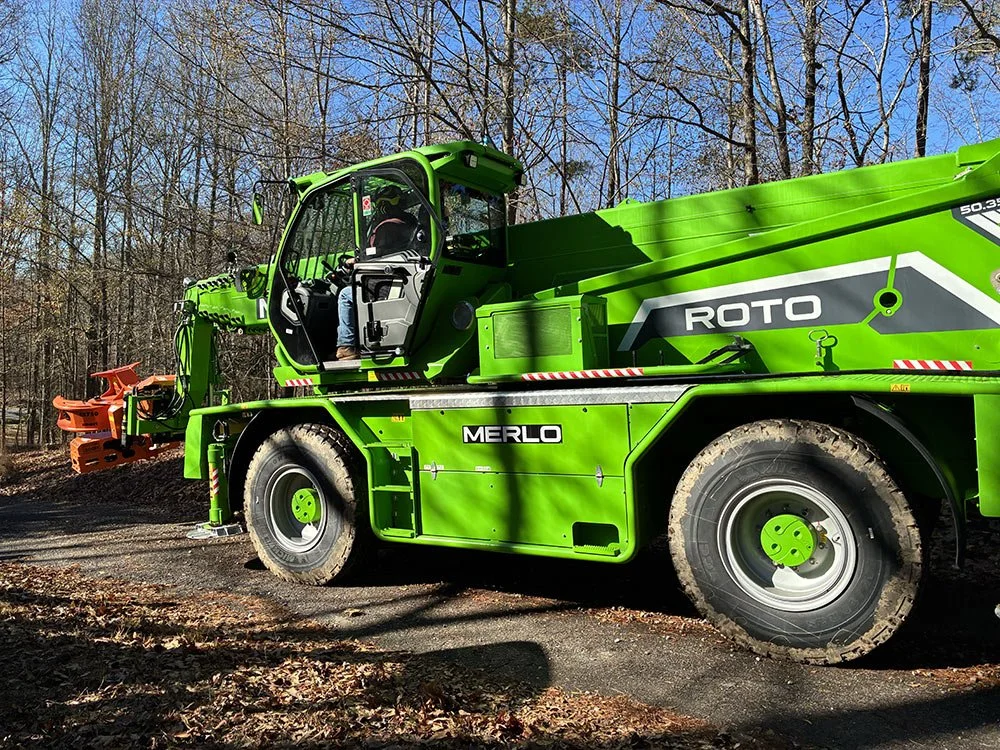
Most tree companies show up with a truck, a chainsaw, and a prayer. We show up with a Merlo Roto 50.35 that reaches 115 feet with full 360-degree rotation, and a Woodcracker CS750 that grips the tree before it ever makes a cut. Nothing hits the ground unless we put it there.
- We work from your driveway or the street
- No heavy equipment tearing up your yard
- Grip-saw holds every piece before cutting
- DOT-compliant fleet, OSHA-trained operators
- We don't leave until the site is clean
- Fully licensed and insured
Better Equipment.
Better Results.
Traditional tree removal means climbers, rigging, and sections of tree crashing to the ground. We skip all of that.
Zero Free-Fall
The Woodcracker CS750 grips the section before it cuts. Every piece is held and lowered to the ground. Nothing falls. Your roof, your fence, your flower beds stay intact.
Minimal Impact
We set up on the driveway or street. No crane pads dug into your lawn, no tracks through your garden beds. We get in, get the tree down, and get out.
115-Foot Reach
The Merlo Roto reaches 115 feet with full 360-degree rotation. Trees that other companies walk away from or need a secondary crane for? We handle those.
When a Tree Becomes
a Problem
Not every tree removal is routine. Some trees are actively threatening your house, tangled in power lines, or one storm away from falling on something expensive. These are the jobs most companies either won't touch or aren't equipped to handle safely.
If any of these sound familiar, don't put it off. The longer a hazard tree sits, the less predictable it gets. We'd rather take it down on our terms than yours.
Get an Emergency EstimateA tree that's shifted toward your house, garage, or fence can't be dropped the usual way. One wrong cut and it goes through the roof.
Dead wood is unpredictable. Branches snap without warning, trunks crack mid-cut. These need to come down before they come down on their own.
You can't just drop a tree that's touching power lines. This takes coordination with the utility company and equipment that can work above and around the wires.
Split trunks, hanging limbs, root balls half out of the ground. Storm-damaged trees are under tension and can move in ways nobody expects.
Big tree in a tight backyard, between two houses, or behind a fence. If a bucket truck can't reach it, most companies pass. Our 115-foot reach solves that.
When a tree grows over something you care about, every single piece has to be controlled on the way down. That's exactly what our grip-saw does.
What's Included in
Every Removal
We don't leave behind a mess. The tree comes down, everything gets hauled off, and the site gets cleaned. That's the standard.
Tree Removal
The whole tree comes down, crown to stump. Grip-saw controlled the entire way.
Debris Hauling
Every branch, limb, and trunk section gets loaded up and hauled off your property.
Site Cleanup
Sawdust, wood chips, leaves, bark. We clean it all up before we pull out.
Final Walkthrough
We walk the property with you before we leave. If you're not satisfied, the job isn't done.
From First Call to
Clean Property
Four steps. No runaround.
Submit Your Estimate
Snap a photo of your tree and tell us what's going on. You'll get a ballpark estimate back in under 30 seconds.
On-Site Evaluation
We come out, look at the tree in person, and give you a firm number. No surprises on job day.
Scheduled Removal
Full crew, full equipment, on the date we agreed. Most single-tree jobs wrap in a day.
Clean & Clear
Everything gets hauled off and the site gets cleaned up. We walk it with you before we leave.
What to Know Before You Remove a Tree
We get calls every week from homeowners in Gainesville, Cumming, Flowery Branch, Dahlonega, and across Hall and Forsyth counties who've been staring at the same tree for months. Sometimes it's a dead oak that lost its last leaves two seasons ago. Sometimes it's a pine that's been slowly leaning since the last big storm. Either way, the question is usually the same: is this something I need to deal with now, or can it wait?
Short answer: if you're asking, it probably shouldn't wait much longer. Dead and dying trees don't get more stable over time. Root systems rot, trunks hollow out, and branches get brittle. A tree that looks like it's just standing there is often slowly losing its ability to stay standing. The homeowners who call us after a tree falls almost always say the same thing: they knew something was off but figured they had more time.
Signs a tree might need to come down
You don't need to be an arborist to spot the warning signs. Mushrooms or fungus growing at the base usually means root decay. Large dead branches in the canopy, especially on one side, can signal internal rot. Cracks in the trunk, bark peeling away in sheets, or a visible lean that wasn't there before are all worth paying attention to. If the tree is within falling distance of your house, your neighbor's house, a power line, or anywhere someone parks or walks, it's not really a "wait and see" situation anymore.
There's also the less obvious stuff. A tree can look green and full from the ground but be hollowed out inside. We've taken down trees in Jackson County and Dawson County that looked healthy from the street but had six inches of solid wood around a completely empty trunk. That's not something you can see from your back porch.
Tree removal permits in Georgia
Georgia doesn't have a statewide tree removal permit requirement, but some cities and counties do. Gainesville, for instance, has tree ordinances that apply to certain sizes and species. Forsyth County and parts of Gwinnett County have their own rules. If you're inside city limits, it's worth a quick call to your local planning or code enforcement office. We can usually point you in the right direction when we come out for the on-site visit.
Tree removal vs. tree trimming
Not every problem tree needs to come all the way down. If the tree is healthy but has dead branches, overgrowth, or limbs threatening a roof line, pruning might be enough. We do pruning too, and we'll tell you straight if that's the better call. But if the trunk is compromised, the lean is structural, or the root system is failing, trimming won't fix what's wrong. Removing it is the only move that actually solves the problem.
Insurance and tree removal
This one comes up a lot. If a tree falls on your house or a covered structure during a storm, most homeowner's policies will cover removal as part of the damage claim. But if the tree is still standing and you want it removed preventively, that's typically out of pocket. Some policies cover removal of a fallen tree that's blocking a driveway or accessible area even if it didn't hit anything. Worth checking your policy or calling your agent before assuming either way. Blake, one of our co-founders, comes from an insurance background and has seen both sides of these claims and can usually give you a realistic read on what to expect.
Why equipment matters more than most people think
Most tree companies in the Gainesville and North Georgia area use the same basic setup: a bucket truck, a climber, rigging ropes, and a ground crew. It works. But it's slow, it puts a person 60 feet in the air next to a compromised tree, and every cut section free-falls to the ground. If that tree is over your deck or next to your garage, free-falling wood is a real problem.
We took a different approach. The Merlo Roto 50.35 reaches 115 feet from the ground with 360-degree rotation, and the Woodcracker CS750 grapple saw grips every section before cutting. Nobody climbs. Nothing falls. We've used this setup on jobs in Cumming, Braselton, Cleveland, and Winder where traditional methods would've meant either renting a separate crane or telling the homeowner we couldn't do it safely. That doesn't happen with our equipment.
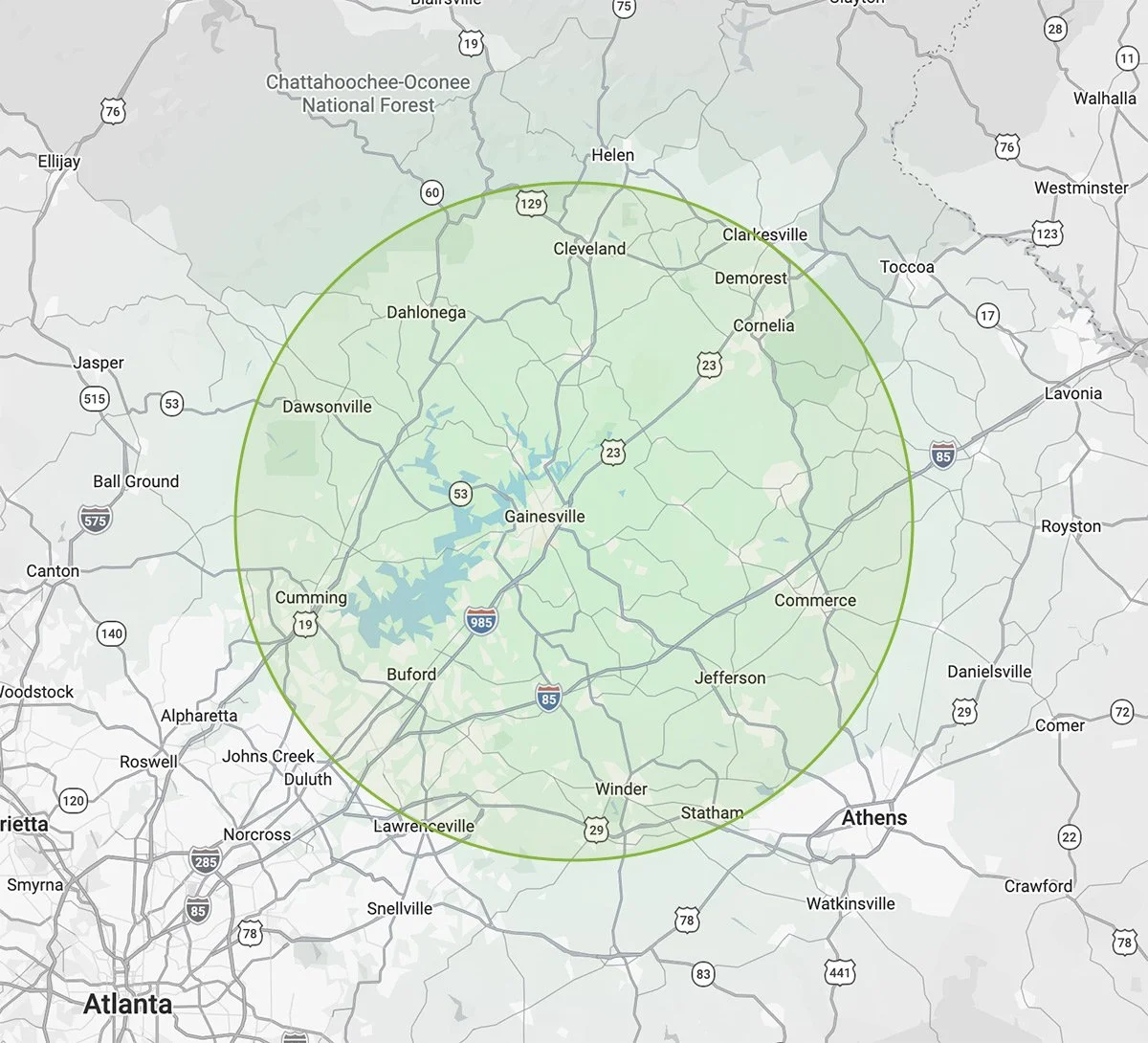
Serving North Georgia
Residential and commercial. If your county is listed below, we can get to you.
Tree Removal FAQ
It depends on the tree. How tall, how close to the house, whether there are power lines, and how easy it is to get equipment in. Use the estimate tool above to get a ballpark from a photo, and we'll confirm the number with an on-site visit.
We serve North Georgia, including Hall County, Forsyth County, Jackson County, Dawson County, White County, Banks County, Gwinnett County, and Habersham County. Our base is in Gainesville, GA.
The Woodcracker CS750 is a grapple saw. It grips the section of tree before it cuts. Once cut, the piece is still held and gets lowered to the ground. With traditional methods, cut sections drop. With ours, nothing falls.
Yes. We carry general liability insurance, our fleet is DOT-compliant, and our operators are OSHA-trained. We'll send over proof of insurance if you need it. Just ask.
Most single-tree jobs wrap in one day. Bigger trees, tight access, or power line work can push it longer. We'll give you a time estimate when we come out to look at it.
We cut the tree as close to ground level as we can. Stump grinding is available as an add-on if you want it gone completely.
Yes. Tree on your house, blocking your driveway, or about to fall? Call us at (770) 652-4249. You can also mark it as an emergency in the estimate tool above and we'll bump it to the front of the line.
We set up on the driveway or street whenever we can. Traditional cranes need outrigger pads on your lawn. Ours doesn't. Most customers are surprised how little trace we leave.
There's no statewide permit requirement, but some cities and counties have their own tree ordinances. Gainesville, parts of Forsyth County, and some Gwinnett County jurisdictions all have rules on the books. If you're inside city limits, check with your local code enforcement office. We can point you in the right direction when we come out for the estimate.
A few things to look for: mushrooms or fungus growing at the base, large dead branches (especially clustered on one side), bark falling off in sheets, cracks in the trunk, or a lean that's gotten worse over time. A tree can also look fine from the ground but be hollow inside. If something looks off, it's worth getting eyes on it.
If a tree falls on your house or a covered structure during a storm, most policies cover removal as part of the damage claim. Preventive removal of a standing tree is usually out of pocket. Some policies also cover removal if a fallen tree is blocking your driveway or an accessible area. Check your policy or call your agent. One of our co-founders has an insurance background, so we can usually give you a realistic read on what to expect there too.
Trimming (or pruning) takes off dead branches, overgrowth, or limbs that are threatening a roof line. The tree stays. Removal takes the whole thing down. If the trunk is compromised, the lean is structural, or the root system is failing, trimming won't fix it. We do both, and we'll tell you straight which one actually solves your problem.
Call us at (770) 652-4249. We handle emergency removal and can usually get a crew out quickly. From there, your homeowner's insurance typically covers the removal and structural repair. Document everything with photos before anyone starts cleanup. Your adjuster will want to see it.
Yes, and this is exactly the kind of job our equipment was built for. The Merlo Roto can work from your side of the property line and reach over without needing access from the neighbor's yard. That said, if a tree straddles the property line, it's a good idea to have a conversation with your neighbor first.